iIn this article:
Say you run a skincare brand and you need 30 pieces of content this month. You've got two options.
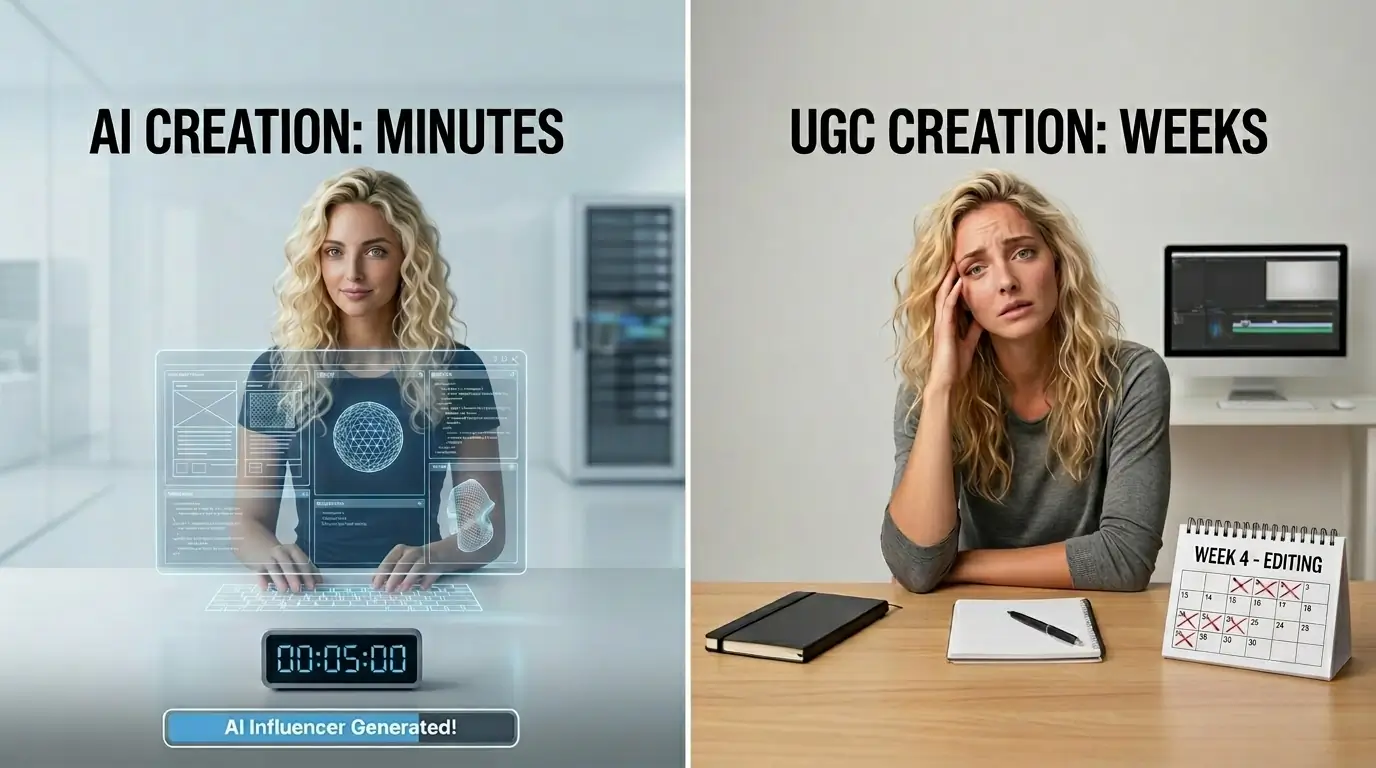
Option one: hire three UGC creators. Budget about $200 per video, so $6,000 for the batch. Add 30–50% for ad usage rights. Wait one to two weeks for deliverables. Hope the first takes are usable, because revision rounds cost time and sometimes money. Coordinate across three different people's schedules. Sign contracts.
Option two: build an AI influencer on a platform like The Influencer AI. Generate all 30 images that afternoon. Total cost: your $19/month subscription and an hour of your time.
Neither option is automatically the right call. That depends on what you're selling, where you're posting it, and what your audience actually responds to. Most of the advice online treats the AI influencer vs. UGC creator decision like a philosophical debate about “authenticity vs. efficiency.” It's not. It's a resource allocation decision, and it has a correct answer for your specific situation.
Wait, What’s the Difference?
They're not the same thing, but they do compete for the same content budget. So let's define the difference clearly.
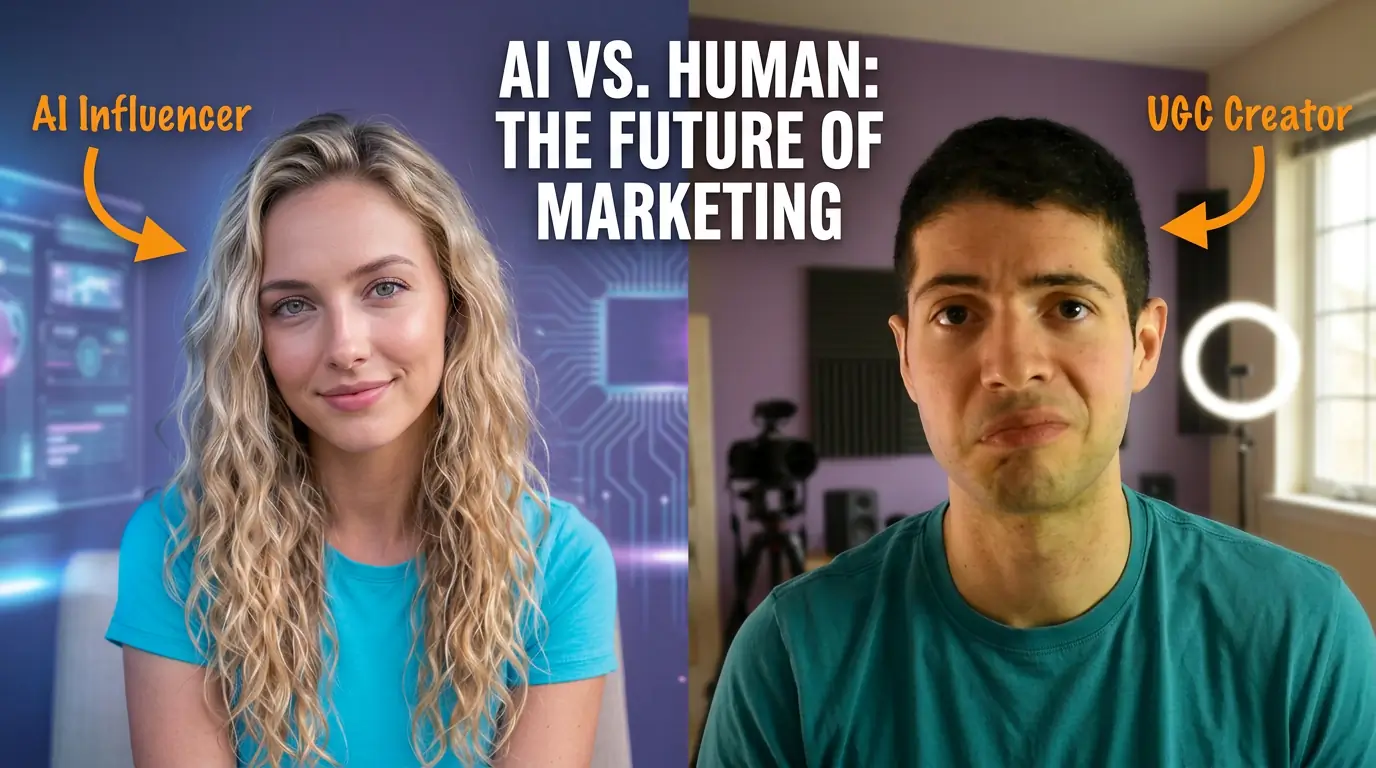
If you want the longer definition, start with what is an AI influencer. In practice, an AI influencer is a fully synthetic persona. Brands use an AI influencer generator like The Influencer AI to design the appearance, generate photos and videos, and own everything outright. No model releases, no exclusivity contracts, no “sorry, I'm booked until August.” The brand controls the character completely. Some AI influencers have become social media personalities in their own right (Lil Miquela has millions of followers), but most are created by brands as private content tools.
A UGC creator is a real human you pay to make content that looks organic. They're not selling access to their audience (that's what separates them from traditional influencers). You're paying for their ability to hold a product, talk to a camera, and make it feel like a genuine recommendation rather than an ad. Average rate in 2026 is somewhere around $150–300 for a short video, though specialists in niches like tech or fashion charge more.
Both produce content for your brand. The similarity ends there.
The Cost Math
Let's get specific, because vague comparisons don't help anyone make decisions.
UGC at scale: Ten videos a month from decent creators will run you $1,500–3,000. That's base rates only. Most creators charge extra for ad usage rights (typically 30–50% on top), and you'll spend additional time on briefing, feedback loops, and project management. Want to scale to 40 videos per month? Multiply accordingly. UGC costs are linear: double the content, double the spend.
AI influencer at scale: A subscription to a platform like The Influencer AI costs $19/month on the starter plan. Generate four photos or four hundred, same price. Per-asset cost is essentially nothing once you're past the subscription. And there are no usage rights to negotiate because you own everything by default.
UGC Creator
10 videos/month
$1,500–3,000
50 assets/month
$7,500–15,000
Turnaround
1–2 weeks
Usage rights included
Usually no (+30–50%)
AI Influencer
10 images/month
$19–199
50 assets/month
$19–199
Turnaround
Minutes
Usage rights included
Yes, always
But cheaper per asset doesn't automatically mean better value. A $200 UGC video that converts at three times your average click-through rate is worth more than 50 AI-generated photos that nobody engages with. The question isn't which costs less per unit. It's which produces more revenue per dollar. The answer changes based on your product category, your audience, and which platforms you're on.
When AI Influencers Make More Sense
Some situations make the economics of UGC genuinely hard to justify.
You need a lot of visual content, regularly. If your social calendar requires 20–40 posts per month and most of them are product photography or lifestyle shots, hiring humans for every single frame is an expensive way to fill a grid. AI-generated content lets you test 20 AI UGC ad variations where you'd previously budget for three. E-commerce brands running Instagram shops figured this out early: content production costs drop by 70% or more after switching product photography to AI-generated images. If you want the actual workflow, see our guide on how to create an AI influencer like Aitana Lopez.

Consistency matters more than spontaneity. Same face across every touchpoint, every platform, month after month. No creator turnover, no schedule coordination across timezones, no “my usual model moved to Berlin.” For brands building a recognizable character or mascot, this is worth a lot.
You want to iterate fast. Don't like the background? Regenerate in minutes. Want to see the same outfit in five different settings? Done before lunch. Rebriefing a UGC creator, waiting for their availability, reviewing new cuts, requesting changes… that's easily a week per round. Speed of iteration is one of those advantages that sounds minor until you're trying to A/B test ad creatives at any kind of pace.
Brand safety is a priority. Your AI influencer won't post something controversial on their personal account, won't show up in a competitor's campaign next month, and won't negotiate a higher rate because their follower count grew. You get total control, permanently. That predictability is genuinely valuable, even if it's not the most exciting pitch.
The data backs this up. Industry writeups report average ROI figures around 13.7% versus 12.3% for traditional influencer campaigns1, with some reported case studies showing production costs roughly 76% lower2. Hyundai ran a campaign with an AI influencer that generated 20x ROI and was described as the brand's most successful influencer product launch to date3.
Sources
- Communicate Online: “The Rise of Virtual Influencers to Disrupt the Influencer Marketing Industry.”
- Marketing Agent Blog: “Virtual Influencers vs. Human Influencers: A Data-Driven Comparison for 2025.”
- The Gradient Group: “What the rise of AI influencers means for marketers.”
When UGC Creators Make More Sense
AI can't do everything. And in some categories, trying to replace human creators with synthetic ones will actively hurt your conversion rates.
Your product needs trust before purchase. Supplements, baby products, skincare with specific claims, financial tools. When people Google reviews before they buy (and they do, for these categories), a real human describing their actual experience carries weight that a synthetic face can't replicate. You might know your AI influencer is “fake” and not care. Your customers in these categories absolutely will.
You're building for TikTok organic. TikTok's algorithm rewards content that feels native, unpolished, real. UGC creators are professionally good at looking unprofessional. That's not an insult, it's literally their skill. AI-generated content tends to look too clean for TikTok, which is actually a disadvantage on a platform where “overproduced” is the kiss of death. This might change as AI video gets better, but right now, for TikTok specifically, human creators still have an edge. If you're working on talking videos,how to fix AI lip sync is usually the first technical problem to solve.
Genuine reactions matter. An unboxing where someone's actually surprised. A taste test with a real facial expression. A before-and-after with actual skin, actual lighting, actual mess. AI can simulate these scenarios, but motion and micro-expressions still hit different when they're real. There's an uncanny valley in video that doesn't exist in static photos, and audiences pick up on it even when they can't articulate what feels off.
You're trying to build community, not just fill a calendar. Real creators interact in real comment sections and bring real connections. An AI persona can engage through clever copywriting, and some brands do this well, but the relationship is fundamentally different. If community is part of your growth strategy (and for a lot of DTC brands, it should be), you need humans somewhere in the mix.
Why AI Influencers Are Now the Default
A year ago, the smart advice was “use both.” And it was true. AI-generated content wasn't good enough to carry a brand's entire visual identity. You still needed human creators for the hero moments and AI for the filler.
That's not where we are anymore.
In 2026, AI influencer content is the default for everything except a narrow band of trust-heavy categories. Product photography, lifestyle shots, social grid content, ad creative variations, seasonal campaigns, brand storytelling: AI handles all of it faster, cheaper, and with more consistency than any roster of human creators.
The brands still spending $3,000-10,000 a month on UGC for commodity visual content aren't being thorough. They're being slow.
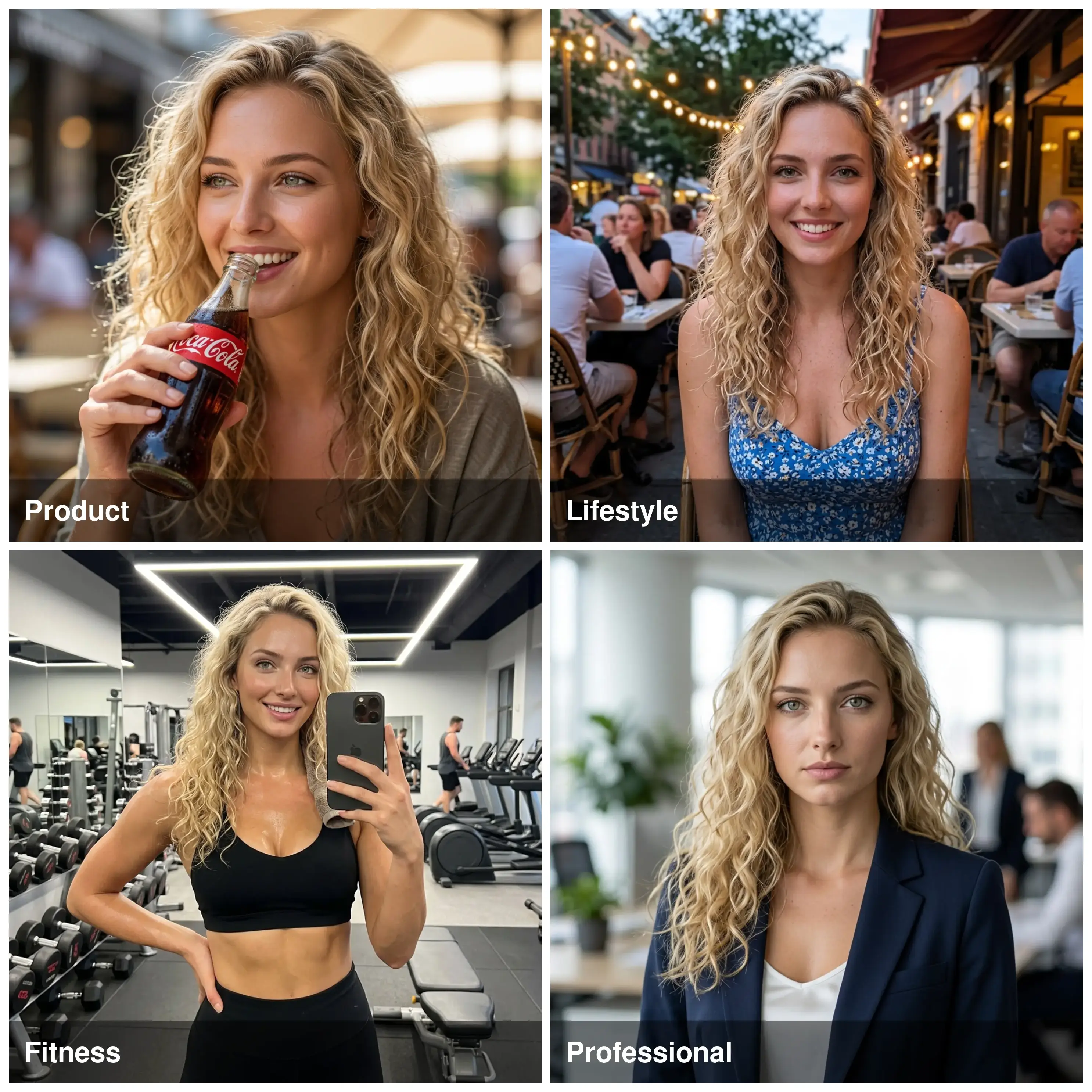
Here's what an AI influencer can do right now: not in theory, not “with the right tools,” but today, on a $19/month subscription:

That's Mari. She's not real. This video was created in under 10 minutes. She's speaking, expressing, making eye contact. And she'll do it again tomorrow in a different outfit, for a different product, in a different language, without renegotiating her rate.
The question isn't whether to use AI influencers or UGC creators. For most brands, AI influencers are the obvious starting point. If you're in one of the few categories where customers genuinely need to see a real human react before they buy (supplements, baby products, financial tools), keep a UGC creator or two for those specific moments. Everyone else: start with AI and add humans only when you hit a wall.
If you are choosing between AI UGC platforms, the more specific question is whether you want a shared actor for individual ads or one owned AI influencer you can reuse everywhere. We break that down in our Arcads alternative for AI UGC guide.
You probably won't hit a wall.
See what an AI influencer can do for your brand.
Create Your AI InfluencerA Note on Disclosure
The FTC now expects what they call “double disclosure” on AI influencer content: you need to mark it as both sponsored and AI-generated. The EU has similar requirements under the AI Act. This sounds like a headache, but in practice it's just a label.
There's an interesting wrinkle here: early data suggests audiences don't punish AI content as much as marketers expect, as long as the disclosure is upfront and honest. The backlash comes from getting caught hiding it, not from being transparent about it. Just label it and move on.
The bottom line: AI influencers aren't the future of brand content. They're the present. The only question is whether you start now or keep overpaying for commodity content while your competitors figure it out.
Frequently Asked Questions
What is the difference between an AI influencer and a UGC creator?
An AI influencer is a fully synthetic persona. You design the appearance, generate all photos and videos, and own everything outright. A UGC creator is a real person you pay to produce content that looks organic. Both create brand content, but AI influencers offer total control and lower per-asset cost, while UGC creators bring genuine human reactions and trust.
How much does an AI influencer cost compared to a UGC creator?
An AI influencer platform like The Influencer AI starts at $19/month for unlimited image generation. UGC creators typically charge $150–300 per short video, plus 30–50% extra for ad usage rights. At 10 videos per month, UGC runs $1,500–3,000 versus essentially the subscription cost for AI-generated content.
Can AI influencers replace UGC creators entirely?
For most brands, almost yes. AI influencers can now cover product photography, lifestyle content, social posts, ad creative variations, and most brand imagery. UGC creators still win in narrow trust-heavy categories like supplements, baby products, or financial tools where customers want to see a real human reaction before they buy.
Should my brand use both AI influencers and UGC creators?
For most brands, AI influencers should be the default. The only categories where UGC creators are clearly better are those requiring genuine human trust signals, like supplements, baby products, and financial tools. For everything else, AI influencer content is faster, cheaper, and more consistent.
Do I need to disclose AI-generated influencer content?
Yes. The FTC now expects double disclosure on AI influencer content: marking it as both sponsored and AI-generated. The EU has similar requirements under the AI Act. Early data suggests audiences respond well to transparent labeling. The backlash comes from getting caught hiding it, not from being upfront about it.
Related guides
Deep Dive
What Is an AI Influencer?
The complete guide to AI influencers: how they work, real examples, business models, and the ethical considerations you should know.
Tutorial
How to Create an AI Influencer Like Aitana Lopez
Step-by-step guide to designing, training, and monetizing a consistent virtual influencer people recognize.