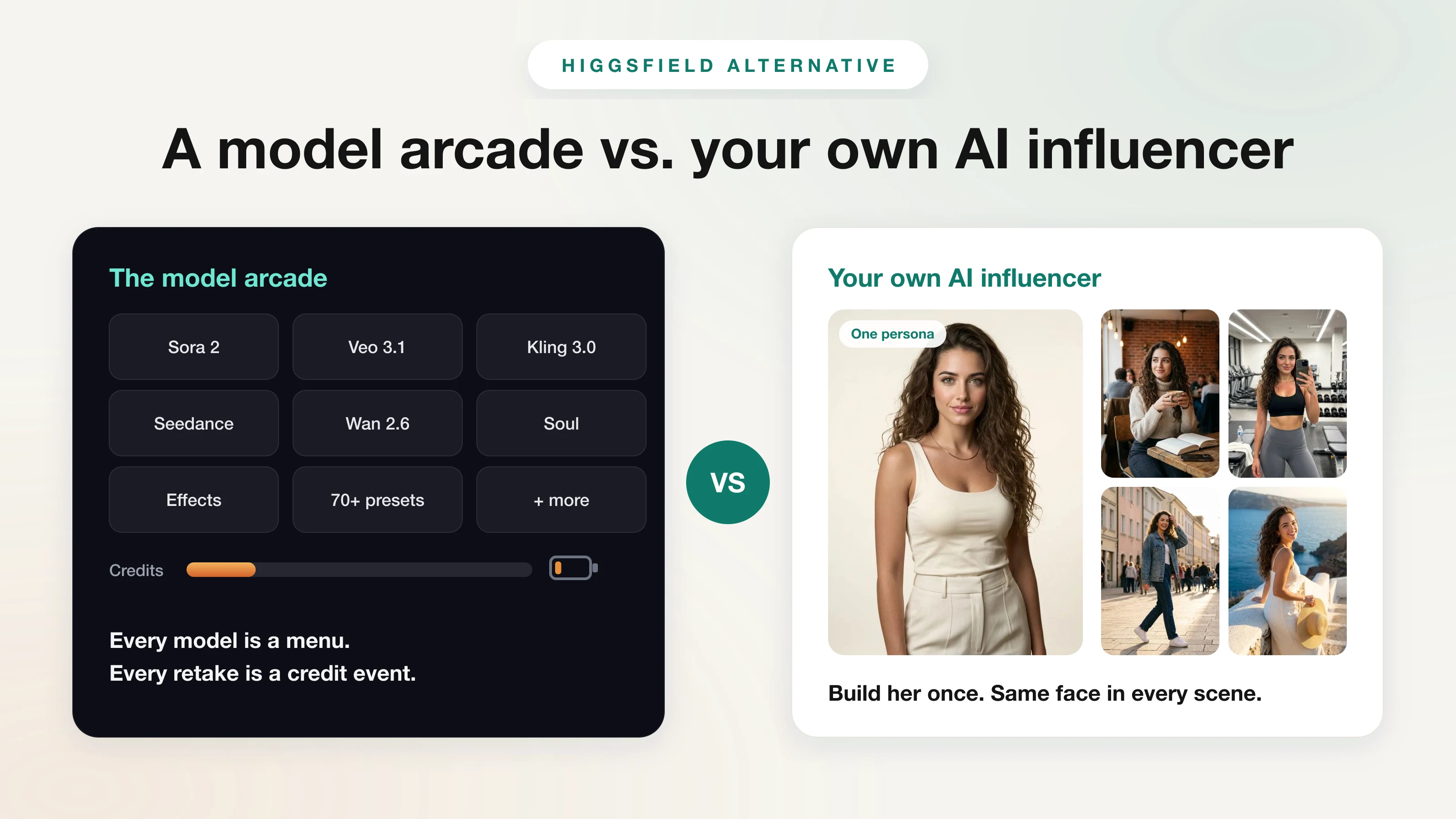
The best Higgsfield alternative is The Influencer AI, an AI influencer generator and studio built for the job most people actually bring to these tools: photorealistic AI influencers you own, one persona or a whole roster. You ship finished content with them: photo batches, real edits and product combines, short video with native audio, lip sync in 40-plus languages. The philosophical difference is simple. Higgsfield is a model arcade: over a hundred image, video, and voice models by its own count, 70-plus camera presets, and an ever-growing effects wall, priced so that every attempt burns credits. The Influencer AI keeps you on flagship models it has already tested, at flat published prices, and will never slow you down on purpose.
If you came to Higgsfield to run an AI influencer or a steady UGC pipeline, you'll hit three walls there: an "unlimited" plan with a battery, credits that evaporate on retakes, and consistency you have to train instead of own. Here's the honest breakdown.
Here's the short version, since that's probably what you came for:
Built for
Exploring 15+ models, presets, and effects
Shipping content with influencers you own
Model choice
A menu you pay to navigate (7-110 credits/clip)
Flagship models picked and managed for you
Generation speed
“Unlimited” waits in a throttled standard queue
Never slowed down on purpose
Character consistency
Soul ID: train it from ~20 real photos
Built in: pick traits or upload selfies
Free trial
$0-for-1-day offer that auto-renews into Plus
3-day trial with free credits
What one generation buys
A raw pull on whichever model you picked
Your influencer, in the shot, on-brand
Starting price
€19/mo Starter (EU, before VAT): selected models only, no unlimited perks
$19/mo, month to month, cancel anytime
The rest of this explains what kind of product Higgsfield actually is, the fine print people only discover after paying, and the cost math that makes the decision for you.
How we researched this, and who "we" are
We build The Influencer AI, one of the two tools compared here, so read this as our best honest case rather than neutral journalism. Higgsfield facts come from its live pricing page and FAQ (checked and screenshotted July 23, 2026), its own blog, and complaint themes across Trustpilot, the BBB, and Reddit threads from late 2025 through mid-2026. Prices and plans change; verify anything that matters at the source before you buy.
Build your first AI influencer
Create influencers you own, then reuse them across photos, product shots, video, lip sync, and ads.
In this comparison
What Higgsfield actually is: a model arcade
On paper, Higgsfield is the everything-app of AI video: Sora 2, Veo 3.1, Kling 3.0, Seedance 2.0, Nano Banana, its own Soul image model, over a hundred models by its own count, plus 70-plus cinematic camera presets and an effects wall that grows every week, all behind one login. That breadth is the pitch. The question the demo reel never answers is what breadth costs when you're the one holding the meter.
Because look at what kind of product a model aggregator is: an arcade. It's built for wandering, try this model, try that preset, try a different seed, see what comes out. Every pull of the lever is a credit event, and the menu varies wildly by machine: per Higgsfield's own rate table, a 5-second Kling 3.0 clip runs 7 credits at 720p while a Seedance 2.0 clip runs 22 at 720p and 110 at 4K. The business model works precisely because exploring is open-ended, and because you, not the platform, absorb the cost of finding out which model was right for the job.
Most people searching for a Higgsfield alternative aren't leaving because they ran out of models to try. Two frustrations come up again and again. The first is that a good result is a research project: which model, at which resolution, with which settings, for this particular kind of shot. That's real expertise, every wrong guess is metered, and the menu changes often enough that the learning never sticks. The second is the word "unlimited," which turns out to mean a throttled queue, and nothing sours a paying customer faster than a plan that gets slower the more they use it. If your job is recognizable faces shipping content every week, AI influencers, brand personas, recurring UGC creators, you don't need a hundred machines. You need a studio that has already worked out which engine fits the job and remembers who your personas are.
None of this makes Higgsfield useless. It makes it a specific product: a place to wander a wall of machines. If the wandering is the point, fine. If shipping is the point, wandering is the cost.
The "unlimited" plan has a battery
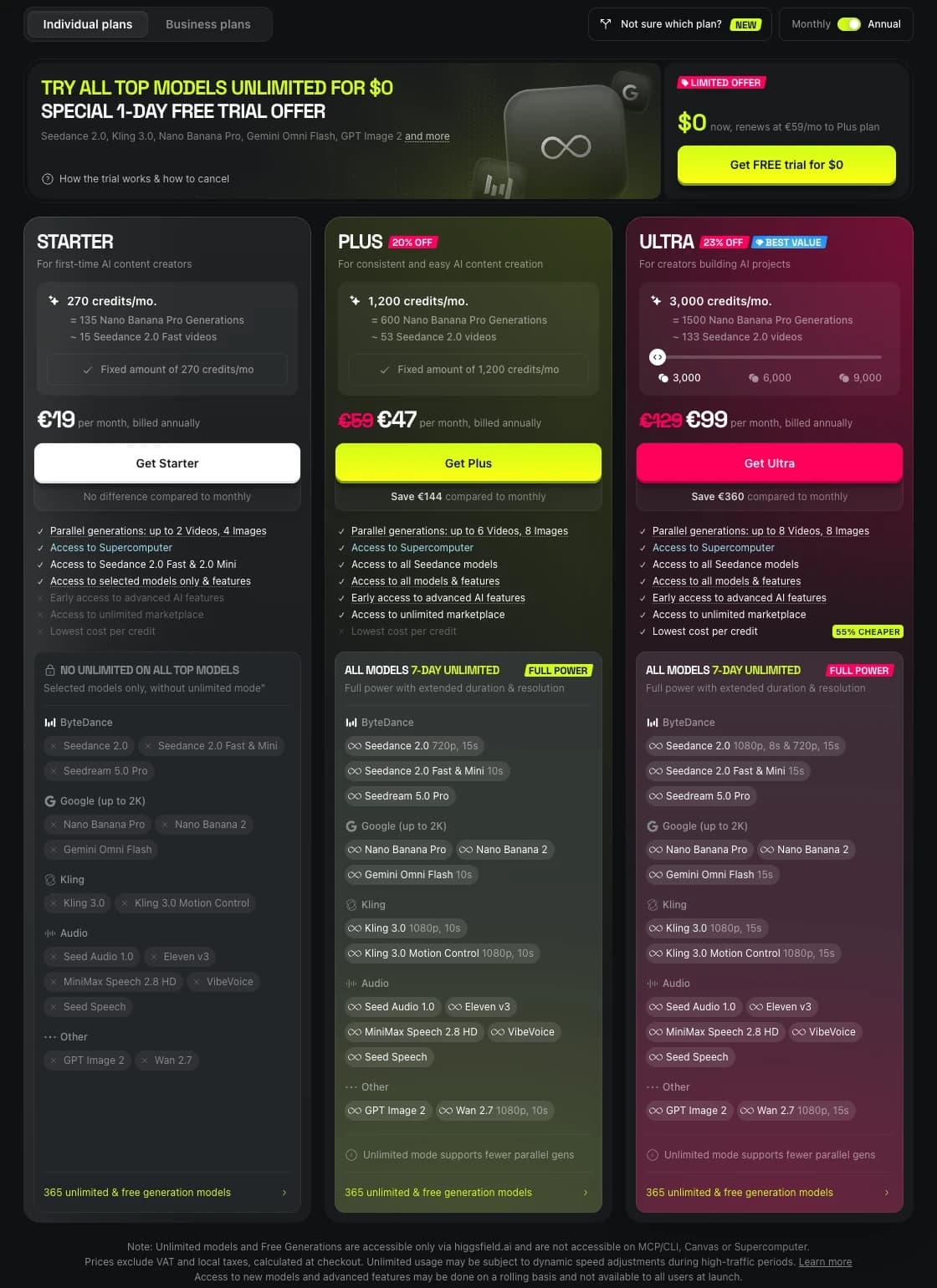
Start with the pricing page itself. As of October 2026 it lists three plans, Starter, Plus, and Ultra, at €19, €59, and €129 a month (Higgsfield localizes currency; these are the EU prices before VAT), or €19, €47, and €99 a month billed yearly and charged upfront. Starter gets 270 credits, selected models only, and none of the unlimited perks.
Plus, at €59 a month for 1,200 credits, is the cheapest plan with the headline feature: "unlimited" generation. That word is doing a lot of work, and it's where most of the public complaints cluster.
Here's how unlimited works, straight from Higgsfield's own pages. The offers are time-boxed, per-model promos: the plan cards literally read "7 days unlimited" next to Kling 3.0 and Nano Banana, on Plus and Ultra only. The pricing page's fine print notes that unlimited usage "may be subject to dynamic speed adjustments during high-traffic periods." And its FAQ describes a two-queue system: unlimited generations wait in the standard queue, credit-based generations always run in the priority queue, and the documented way to get maximum speed back is to switch into credit mode. The fast lane is the one that burns credits, by design.
Users have a name for the slowdown curve: the battery. Reports across Reddit and review sites describe the same model returning clips in about a minute on credits, roughly ten minutes fresh into unlimited, and twenty-five-plus minutes to hours as heavy use stacks up.
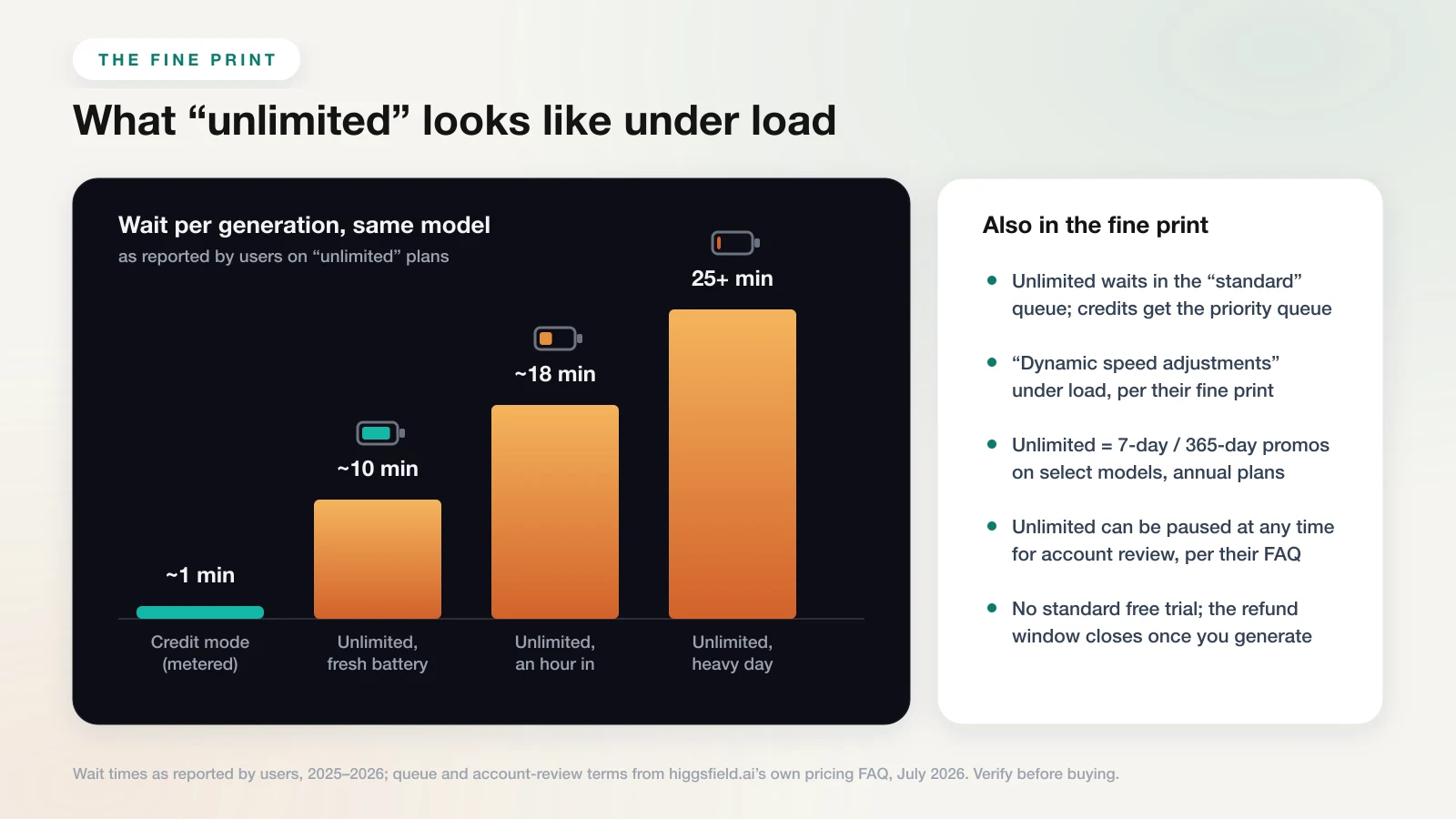
The fine print doesn't stop there. Higgsfield's own FAQ notes unlimited access can be paused at any time for account review if the system flags unusual activity, the official mechanism behind what heavy users described in December 2025 as sudden bans and retroactive plan changes, the wave that filled Higgsfield's Trustpilot and BBB pages with billing complaints.
There's no standard free trial either: the closest thing, as of late July 2026, is a countdown-timer "$0 for one day" offer that auto-renews into the €59-a-month Plus plan, less a free trial than a lit fuse, and refund guides note refunds only apply shortly after purchase if you haven't used any credits, meaning the moment you generate a single test clip, the window closes. Users have also reported the mobile app resetting the unlimited toggle between generations, quietly dropping them back into credit-burning mode.
The Influencer AI's answer to all of this is boring on purpose: it doesn't sell unlimited at all. Plans are flat credit allotments with published burn rates, one credit per photo, 1-2 credits per second of video, extra credits at a flat 24 cents whenever you need them, and a 3-day trial before any money changes hands. And one promise that shouldn't be rare in this market but is: we will never slow you down on purpose. There is no battery, no deprioritized queue, no speed tier waiting to be upsold, the plan you bought is the fast lane. You can compute your month's cost on a napkin, which is exactly the property a content schedule needs.
A face you train versus a persona you own
Here's the part that matters most if you're building anything with recurring characters. Diffusion models have no memory of your character: each generation starts from noise, so faces drift between images, the jawline shifts, the eyes change, the hair moves. That isn't a knock on Higgsfield specifically, and its own blog admits as much, with posts literally titled around why your AI character's face keeps changing.
Higgsfield's solution is Soul ID: upload roughly 20 well-lit photos of a real face, from multiple angles, and train a personal identity model. For its intended job, putting a real person, most likely you, into AI scenes, it can work. But notice the shape of it. It's a training layer bolted on top: the identity gets re-anchored scene by scene, video still runs through whichever model you picked that day, and drift creeps back in at the seams between models and formats.
And if your influencer is fictional, there is no stack of 20 photos to upload; fictional people photograph badly. You'd need a consistent character to create the training set, which is the very problem you came here to solve.
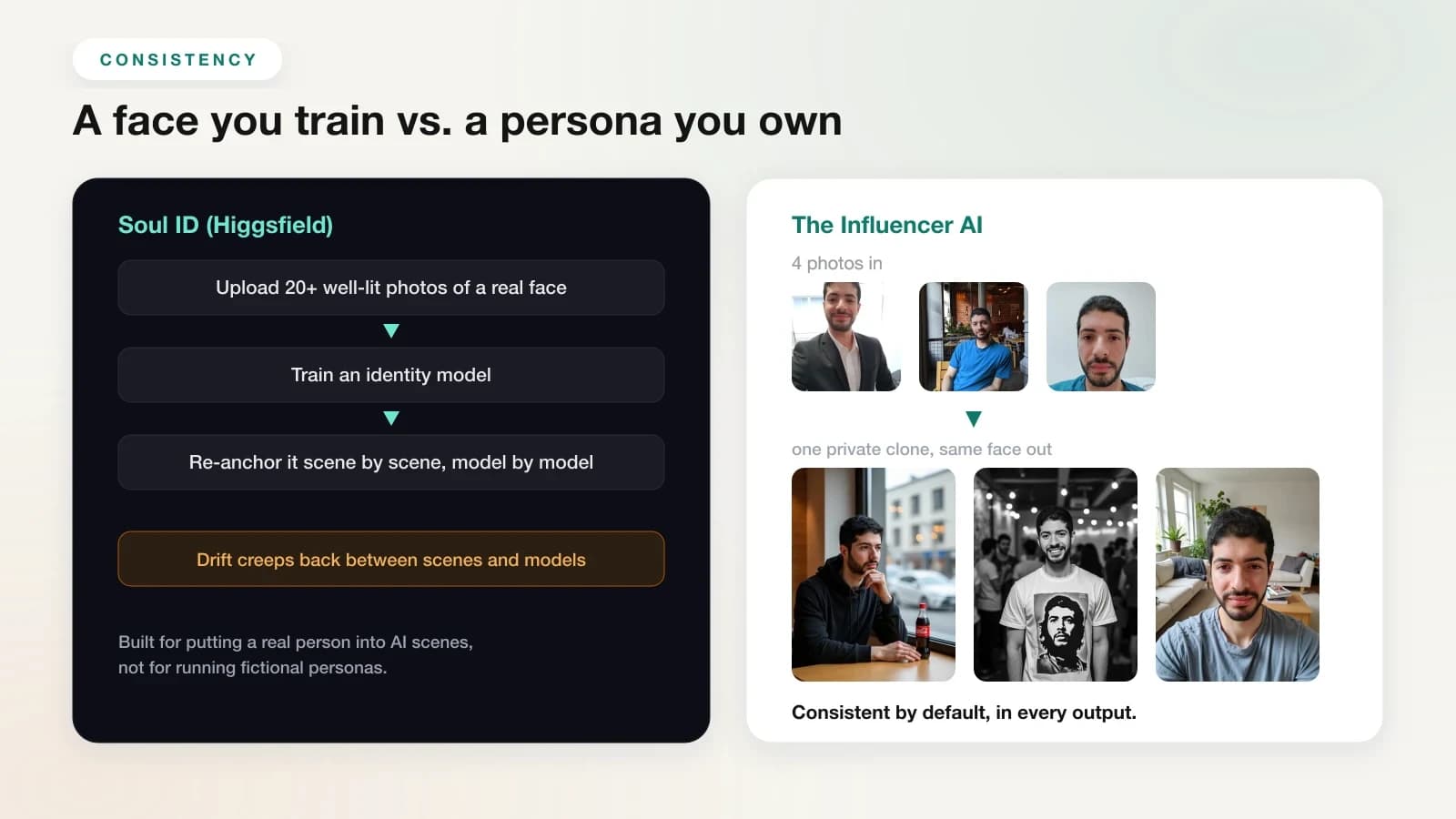
The Influencer AI inverts this. The persona is the primitive the whole product is built on. You create an AI influencer once, by picking traits or by uploading 1 to 4 photos to clone yourself, and from then on that face carries every output by default: batches of up to 32 photos per prompt, 3-15 second videos where your persona looks at the lens, talks, and moves with native audio, lip-synced clips, product edits, try-ons, background swaps. You never re-establish the character, because the character is an account-level asset everything else hangs off.
And you're not rationed to a single face: plans include multiple custom influencers a month, three on Creator, sixteen on Enterprise, plus unlimited pre-made ones, so a brand or agency can run a whole roster where every persona stays consistent.
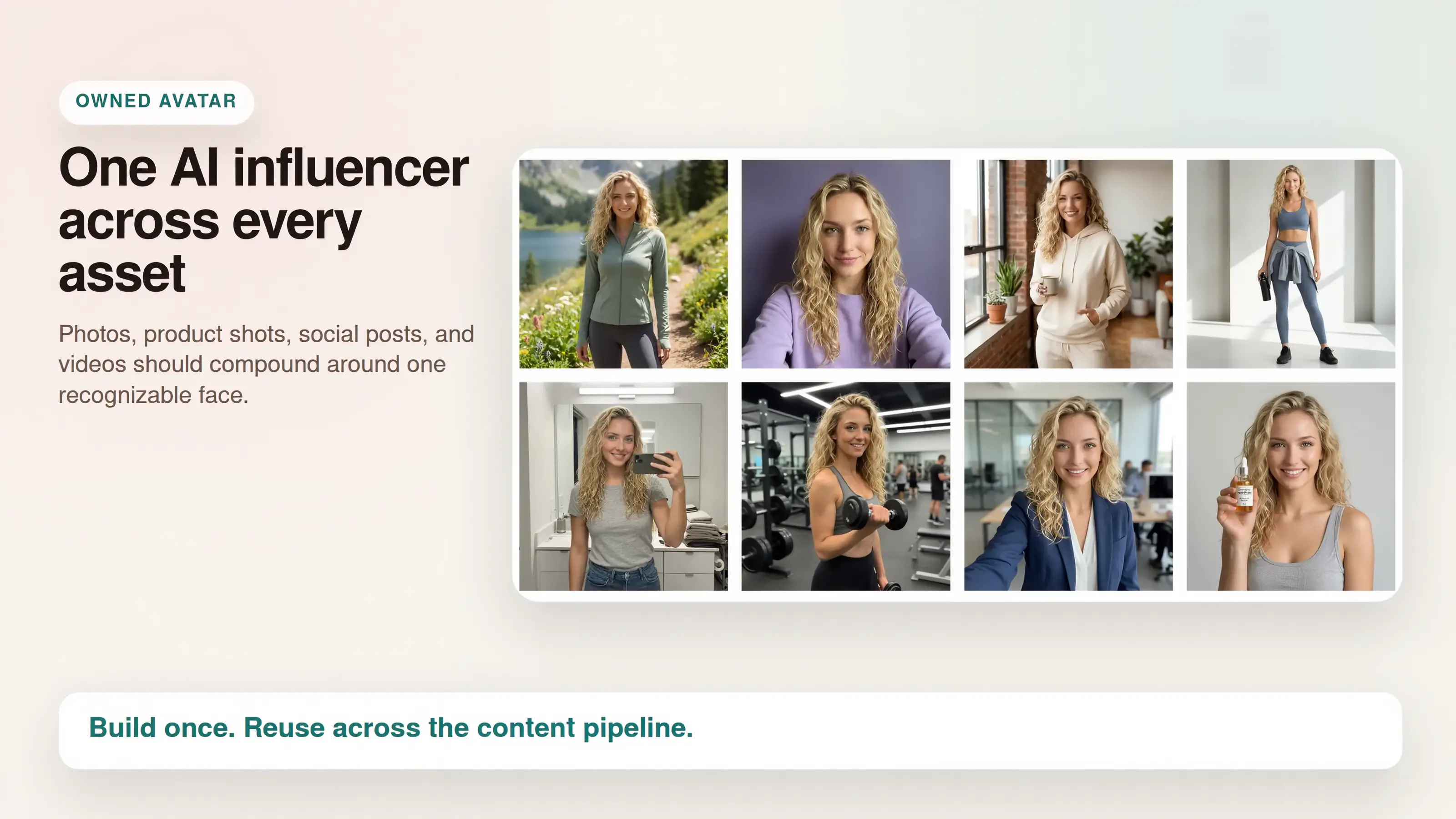
Why this compounds: a face that shows up unchanged, post after post, is a face your audience starts to recognize, and that recognition is the entire point of running an AI influencer instead of a stream of one-off AI clips. A character you re-summon per generation can't accumulate it. Personas you own can.
What about Higgsfield's UGC Builder?
Higgsfield knows UGC is a huge use case, and it ships a dedicated answer: the UGC Builder and its Marketing Studio formats, with 40-plus ready-made avatars, camera presets, accents, and talking-head layouts for TikTok-style vertical clips. If you've seen those and you're wondering whether they close the gap, it's a fair question. Two things still hold.
The stock avatars are shared faces. The 40-plus library avatars are available to every customer, which means the creator vouching for your product this week can be pitching someone else's next week. It's the same structural trade-off we broke down in our Arcads comparison: a rented face can be perfectly realistic and still never become yours. Higgsfield does let you generate custom avatars or train a Soul ID, but then you're back to the training pipeline and the credit meter from the previous sections.
Every ad is a preset-driven one-off. The Builder workflow is pick an avatar, pick a motion preset, pick an accent, type the script, generate. That's efficient for a single ad, but nothing persists: the next ad starts from the menu again, and each output lands back in the credit economy, with lip sync alone tracked at 12-20 credits per clip. It's a vending machine for UGC-shaped videos, not a system for running creators.
On The Influencer AI, the UGC workflow starts from personas you already own: put your influencer in a new scene, hand them your product, generate the talking clip, lip-sync it at 1 credit per second, and re-shoot the same ad in any of 40-plus languages with the same face and voice, no dubbing, no re-shoots. When a trend blows up, motion transfer replicates a reference video's movement onto your persona. The ad is one more output of a character your audience already knows, which is what makes a feed read as a creator instead of a slot machine.
One studio: photos, edits, video, and lip sync
Zoom out to what running AI influencers or a UGC pipeline actually takes in a given week:
- a batch of feed photos for each persona
- product and lifestyle shots, plus edits to images you already have
- a couple of short reels and a talking clip
- versions in another language, if you sell abroad
The question to ask of any tool is how many of those jobs it finishes, and from how many meters.
On Higgsfield, every one of those jobs starts at the menu. Which image model, which video model, which preset, at which credit price, and your characters have to survive every hop.
On The Influencer AI, there is no model menu, because that's our job, not yours. We run flagship image and video models under the hood, test new ones in-house the moment they ship, and swap them in only when they beat what's live. You are always on a frontier model without ever spending 110 credits to discover which one fits the task; that experiment happened before your credits were involved.
And the studio finishes photo jobs, not just clips. Edit images you already have, combine your real product into a shot your influencer is holding, swap backgrounds and outfits, run virtual try-ons, batch up to 32 photos per prompt, all from the same flat credit pool, all with the same faces.
Clone yourself from 1 to 4 photos and everything above applies to you too. The clone is private, locked to your account, and never used to train anything else, and whatever you make ships with full commercial rights.
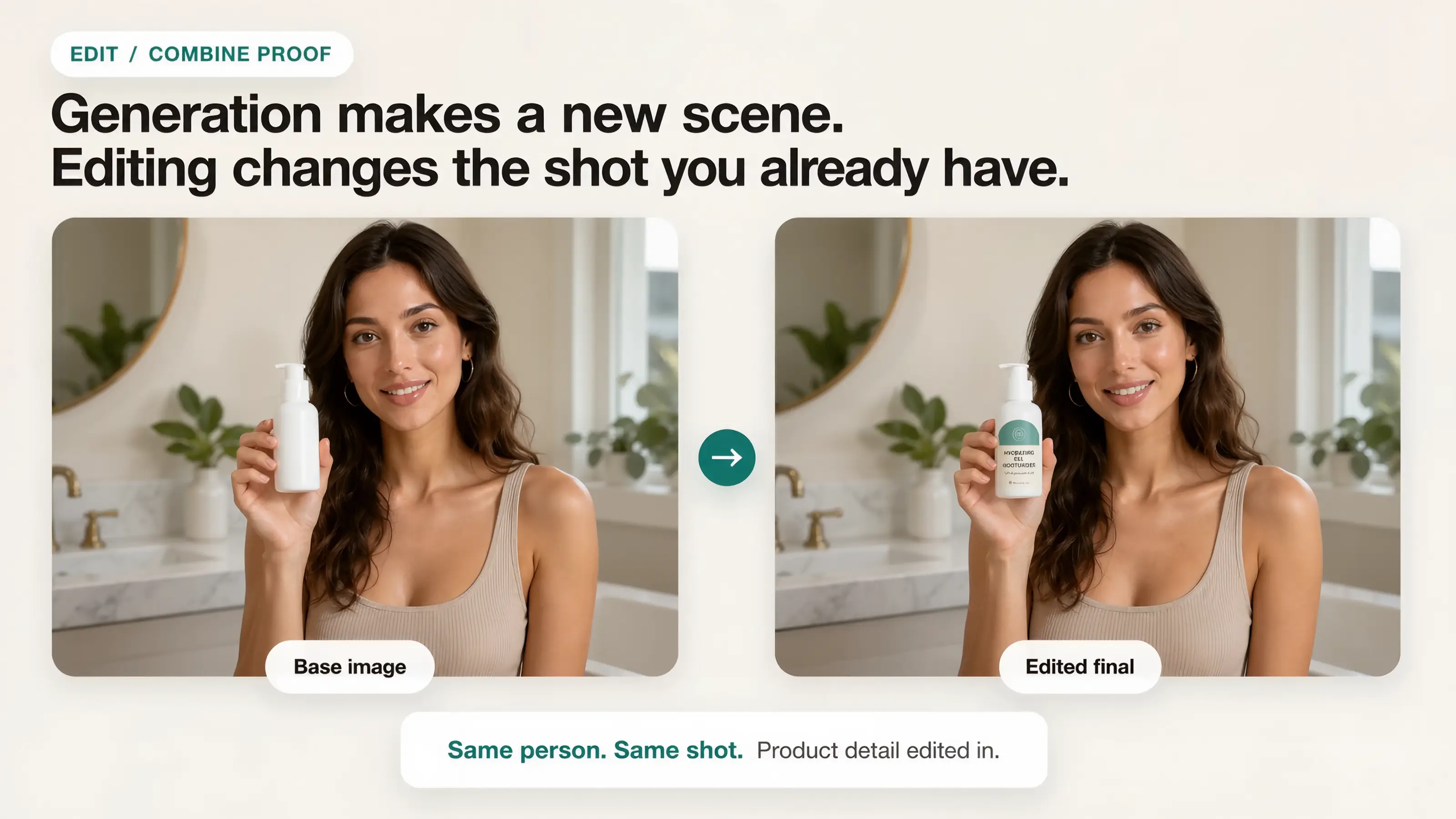
That's the practical meaning of studio versus arcade. A studio is opinionated about the job: it takes your personas and turns them into finished content with as few decisions and as few meters as possible. An arcade is opinionated about options: it gives you every machine and lets you pay per attempt while you figure out the rest.
What creators ship with The Influencer AI
Product promos, shorts, tutorials, and reels, each made with a different creator's persona. Build yours and it keeps one face across everything you publish.




The cost math, with real numbers
Forget "cheaper," and forget credit-versus-credit comparisons entirely. A credit isn't a unit; it's a private currency, and nobody publishes an exchange rate. Higgsfield's credits and ours have different prices and buy different things, so lining up credit counts across platforms is like comparing two price tags in two currencies without converting. Only two comparisons actually mean something: how predictable a month is inside each system, and what one generation actually gets you.
Inside Higgsfield, the currency is volatile. From its own July 2026 rate table (prices localize, so verify your checkout): the same five seconds of video costs 7 credits on Kling 3.0 at 720p, 22 on Seedance 2.0, 45 at 1080p, 110 at 4K. That's a 15x spread for the same clip length, before retakes, and AI video routinely takes several attempts per keeper, each billed like the keeper. It's why a 1,200-credit Plus month is anywhere from about 10 clips to about 170: nobody can budget that in advance.
The plan structure compounds it: the cheapest entry, Starter at €19 for 270 credits, walls off most models and every unlimited perk, and the yearly discount on Plus means paying about €564 upfront.
Inside The Influencer AI, the currency is flat. One photo is one credit. Video is 1-2 credits per second, lip sync is 1 per second, edits and try-ons draw from the same pool, the same rate every time, with no model menu to price-check first. Plans run $19 for 100 credits to $199 for 1,500, month to month, cancel anytime; extra credits are a flat 24¢; a 3-day free trial sits in front of all of it. So a $39 Creator month is roughly 250 photos, or 25-50 short clips, or any mix, and, crucially, you know that before the month starts. The custom influencers and the AI clone aren't metered at all; they're included in the plan.
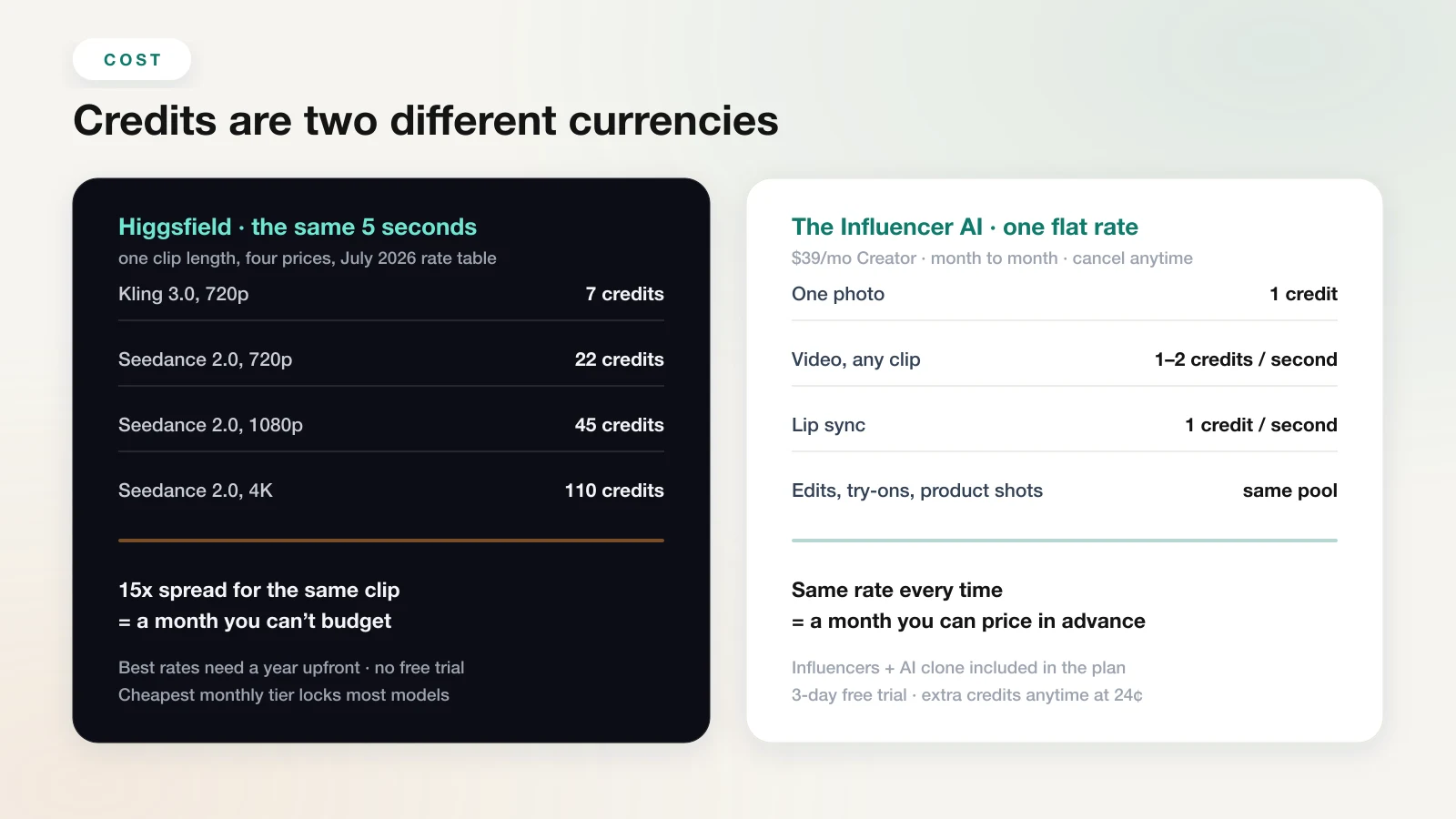
And if you want a common currency, use the only real one: dollars per usable, on-brand output. Here's the honest version. For a raw clip of anything on a budget model, Higgsfield can genuinely be cheap; pay the pull, take what comes out. The economics flip the moment the output has to feature your character. On Higgsfield that means training a Soul ID, re-anchoring it scene by scene, and retaking whenever the face drifts, with every one of those attempts metered. Here, the persona, its consistency, the clone, and the editing come with the plan, so an attempt is almost never wasted rediscovering who your influencer is. Iteration is the whole texture of UGC work. The platform where iteration is cheap, flat-priced, and on-brand by default wins the month, whatever the sticker on a single raw clip says.
See what $19 actually makes
One flat credit pool for photos, product shots, edits, short video, lip sync, and AI UGC content.
So who is Higgsfield actually for?
There's a version of this work Higgsfield fits: experimenting for its own sake. If you want to play with camera presets, poke at every new model the week it drops, and make one-off effect clips where whatever comes out is the deliverable, the wandering is the point and the credit meter is the price of playing. Even then, go in with eyes open and read the unlimited fine print before you pay, especially for a year upfront.
But the moment the work has a deadline or an audience, a brand, a client, a posting schedule, the machine you need changes. You stop needing more models and start needing the same faces at predictable cost, at full speed, every week. That isn't what an arcade sells. It's what a studio sells.
How to decide in one afternoon
You now know what Higgsfield is, what the fine print says, and what the credits actually buy. If model-hopping for its own sake is your idea of the job, nothing here will (or should) stop you. For everyone else, there's a cheaper way to decide than paying for a plan first: run the experiment on the side that's free to run.
Start The Influencer AI's 3-day trial and run the core loop: build an influencer, generate photos of her, drop your actual product into one of the shots, and finish with a short talking clip, in a second language if you sell abroad. Then check two things: whether the same face held across all of it, and what it cost in credits.
You'll know by the end of the afternoon, before you've paid anything, which is exactly the experiment Higgsfield's pricing structure doesn't let you run. And if you're still weighing AI against hiring human creators for UGC, our comparison of AI influencers vs. UGC creators covers that decision. Our comparison of eight AI influencer tools puts Higgsfield next to the rest of the field.
And if you're switching from Higgsfield, the tell is what you can take with you. Batteries drain, promos lapse, and the arcade's machines belong to the arcade. The influencers you build here, and everything they appear in, are the assets you keep.
Create your first AI influencer
Build influencers you keep: photos, product edits, short videos, talking clips, motion transfer, and social ads from faces your audience recognizes.
Create Your AI InfluencerFAQ
What is the best Higgsfield alternative?
The Influencer AI is the best Higgsfield alternative for creators, brands, and agencies that want AI influencers they own: photorealistic personas, or a clone of yourself, that stay consistent across photos, video, lip sync, and edits - on flagship models, at flat published prices, with no throttling. Higgsfield mostly makes sense for one-off, effect-driven clips, if you accept metered credits and the 'unlimited' fine print.
Is Higgsfield really unlimited?
Not in the way most people read the word. The unlimited offers are time-boxed, per-model promos - the plan cards say '7 days unlimited' next to models like Kling 3.0 - and only on Plus and Ultra; Starter has none. Higgsfield's own fine print says unlimited usage may be subject to dynamic speed adjustments during high traffic, and its FAQ explains that unlimited generations wait in a standard queue while credit-based generations always run in the priority queue; switching to credit mode is the documented way to get maximum speed back. Users call the resulting slowdown the battery, with reported waits growing from minutes to over an hour. Verify the current fine print before buying.
Does Higgsfield have a free trial?
Not a standard one. As of late July 2026, the pricing page pushes a countdown '$0 for 1 day' offer that auto-renews into the €59/month Plus plan unless cancelled. Beyond that, third-party guides note refunds are only available shortly after purchase if you haven't used any credits - so the moment you generate a test output, the refund window closes. The Influencer AI has a 3-day free trial with free credits, so you can build an influencer and generate real content before paying.
How much does Higgsfield cost?
As of October 2026 its pricing page shows three plans, billed monthly or yearly (prices shown in euros before VAT for EU visitors): Starter at €19/month for 270 credits, with selected models only and no unlimited perks; Plus at €59/month for 1,200 credits; and Ultra at €129/month for 3,000 or more. Billed yearly and charged upfront, Plus drops to €47/month (about €564 on day one) and Ultra to €99. The Influencer AI runs $19 to $199 per month, billed monthly, cancel anytime, with published flat rates: one photo is 1 credit and video runs 1-2 credits per second. One caution: don't compare credit counts across platforms - each credit is a different currency; compare dollars, predictability, and what an output includes.
Why do Higgsfield credits run out so fast?
Because per-attempt prices are steep, spread wide, and iteration multiplies them. From Higgsfield's own July 2026 rate table: a 5-second Kling 3.0 clip at 720p is 7 credits, Seedance 2.0 is 22 at 720p, 45 at 1080p, and 110 at 4K, and images run 2 credits each. A 1,200-credit Plus month is anywhere from about 10 premium clips to about 170 budget ones - before retakes, and AI video usually takes several attempts per usable clip. That's the arcade economics of a multi-model platform.
Can Higgsfield keep the same character across photos and videos?
Its answer is Soul ID: you upload roughly 20 well-lit photos of a real face and train a personal identity model. That works best for putting a real person into AI scenes. For a fictional persona you first have to generate a consistent set of portraits to train it on, and consistency still has to survive whichever video model each clip runs through. On The Influencer AI, consistency is built in: create each influencer once - from traits or selfies - and every photo, video, and edit uses that same face by default. Plans include multiple custom influencers a month plus unlimited pre-made ones, so you can run a whole roster this way.
Is Higgsfield good for UGC ads?
It can produce them - the UGC Builder offers 40+ ready-made avatars, presets, and talking-head formats. But those stock avatars are shared across customers, the same trade-off we cover in our Arcads comparison, and each ad is a preset-driven one-off rather than content from personas you own. If UGC ads are your main job and you want recognizable recurring faces, a dedicated AI influencer tool fits better.
What does Higgsfield do better than The Influencer AI?
Model choice, if you want it. Higgsfield's menu runs from current models down to older and budget ones - useful if you already know which model to pick, how to configure it, and don't mind paying per attempt while you work that out. The Influencer AI deliberately doesn't offer a menu: you're on flagship models we've already benchmarked and configured, swapped out as better ones ship, so your credits go to content instead of experiments. If hand-picking engines is part of the fun for you, Higgsfield gives you that. If you just want the output, the menu is overhead.
Can I clone myself with The Influencer AI?
Yes. Upload 1 to 4 photos and it builds a private AI clone of you - your face across photos, edits, try-ons, and video, never shared or used to train anything else. Self-cloning starts on the $39 Creator plan. On Higgsfield the equivalent is training a Soul ID from roughly 20 photos, which then still feeds into credit-metered generation across its model lineup.
Can The Influencer AI make talking videos?
Yes. Your influencer can perform on camera with native audio, and lip sync runs at 1 credit per second - with the same face and voice available in 40+ languages, no dubbing, no re-shoots. Short-form video runs 3-15 seconds depending on plan, which matches the UGC and social formats these clips are made for.
Do I get commercial rights to the content?
Yes. Content you create with The Influencer AI comes with full commercial usage rights on paid plans, including ads. As always with AI platforms, keep your own record of what you generate and check the current terms of any tool you use for client work.
How does The Influencer AI pricing work?
Four flat plans: $19/month Starter (100 credits), $39 Creator (250 credits, AI clone, 3 custom influencers a month), $99 Professional (700 credits, 8 influencers), and $199 Enterprise (1,500 credits, 16 influencers) - every plan also includes unlimited pre-made influencers. One credit is one photo; video is 1-2 credits per second; lip sync is 1 credit per second. Extra credits are a flat 24¢ anytime, and there's a 3-day free trial. No battery, no speed tiers, no unlimited asterisk.